Continue with Facebook
 Continue with Email

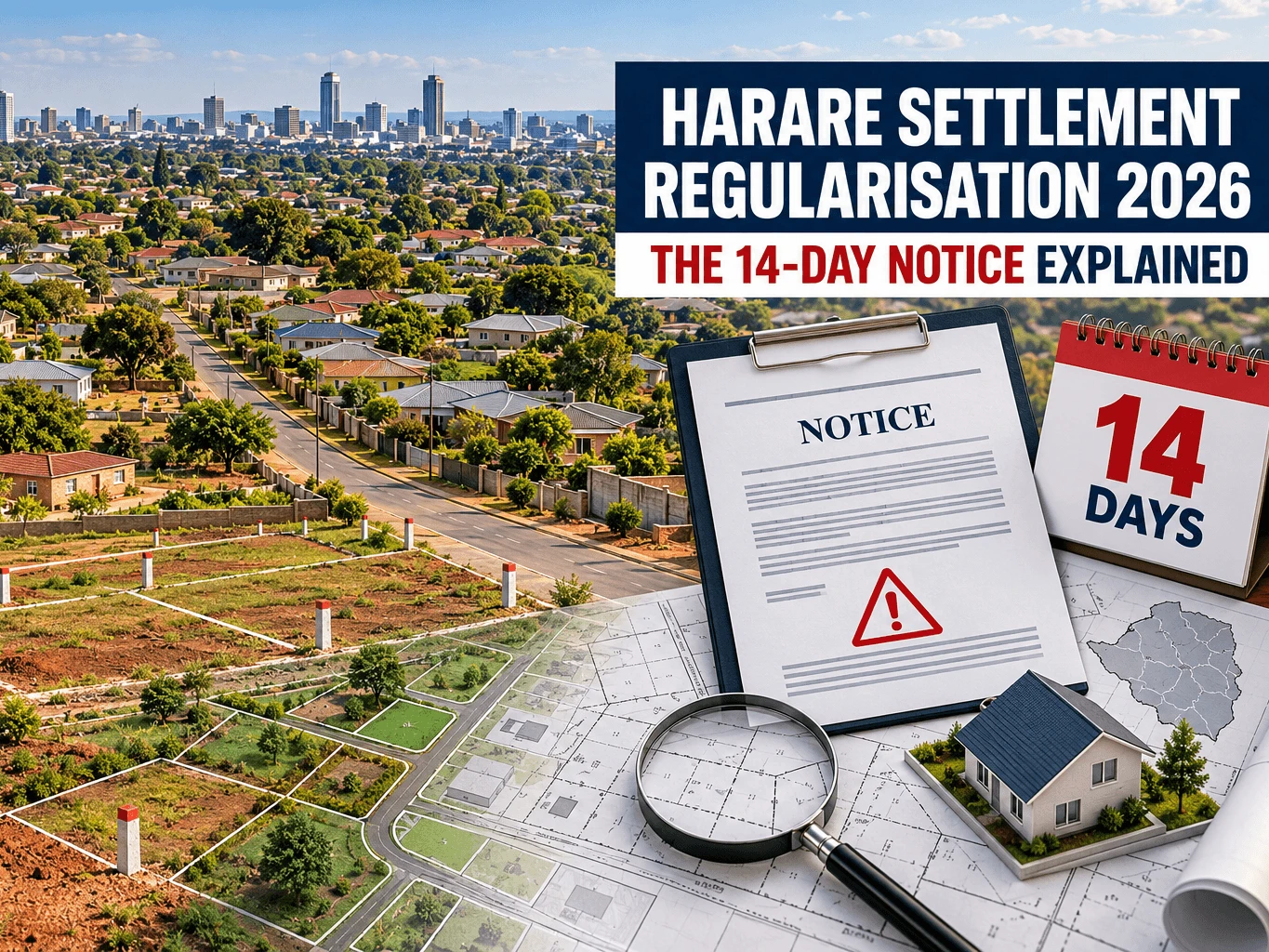
Table of Contents
- Who Does the Harare Regularisation Notice Cover?
- When Does the 14 Day Period End?
- The Six Regularisation Requirements in the Notice
- What Action Does Harare City Council Say It Will Take?
- A Demolition Warning Must Be Read Alongside Constitutional Rights
- Regularisation Does Not Automatically Resolve Title or Building Approval
- Property Risk and Response Matrix
- What Residents and Property Owners Should Do Now
- Two Additional Steps for Buyers and Diaspora Owners
- Where to Make Enquiries
- Conclusion
A partial certificate of compliance does not mean every condition attached to a Harare settlement has been fulfilled. The City of Harare's latest regularisation notice makes that distinction urgent for affected residents, housing associations and property buyers.
In a public notice dated 26 October 2026, signed by W. S. Chiwawa, Acting Town Clerk, the Council gives affected beneficiaries 14 calendar days from publication to comply with outstanding regularisation requirements. It warns of demolition action against non compliant structures and identifies six areas requiring attention, from land payments and building plans to infrastructure.
For the property market, the immediate question is whether the particular stand, beneficiary and development have satisfied the conditions in the Council's records. A certificate, payment receipt or assurance from an association must be checked against that file before further money is committed.
Who Does the Harare Regularisation Notice Cover?
The notice identifies people and legal entities that:
- occupied Council, State or private land within Harare's jurisdiction without lawful authority before the regularisation cut off date of 23 September 2023
- have been recommended for regularisation
- have been issued partial certificates of compliance
It specifically addresses beneficiaries of settlements and associations that received partial compliance certificates but have not fulfilled the regularisation framework's requirements.
This is not a blanket declaration that every property in Harare faces demolition. Nor does occupation before September 2023 automatically establish eligibility for regularisation. The recommendation, certificate, conditions and precise parcel must all be verified.
The notice does not provide a stand by stand or settlement by settlement schedule. A beneficiary should therefore obtain written confirmation from the relevant District Office that their property falls within the affected programme.
When Does the 14 Day Period End?
Publication occurred on 26 October, 14 days later is 9 November 2026. Affected beneficiaries should confirm the Council's operative deadline in writing and begin addressing their file immediately.
The distinction matters because:
- calendar days include weekends
- the stated trigger is publication, rather than the date a beneficiary first receives a forwarded copy
- making an enquiry or lodging documents does not, by itself, establish that the compliance requirements have been met or that enforcement has been suspended.
Where outstanding works cannot realistically be completed within the period, submit a documented proposal promptly and obtain a written decision. The notice does not promise extensions, instalment arrangements or an automatic hold on enforcement.
The Six Regularisation Requirements in the Notice
1. Attend the District Office and Address Occupation Penalties
Beneficiaries of settlements recommended for regularisation are directed to visit their respective District Offices and pay prescribed regularisation penalties for illegal occupation of Council land.
Ask for a written assessment identifying the beneficiary, stand, charge, calculation and official payment channel. The notice also refers to State and private land, so the legal basis and recipient of any payment must match the land involved.
Payments to a cooperative, association or intermediary should be reconciled against the Council's records. An intermediary's receipt does not establish that the municipal obligation has been discharged.
2. Pay the Full Intrinsic Land Value
The Council requires payment of the full intrinsic land value. The notice does not publish a valuation formula, stand specific assessment or universal amount.
Beneficiaries should request:
- the assessed land value and valuation basis
- the party legally entitled to receive payment
- credit for amounts already received and recognised
- the outstanding balance
- the document or right that payment is intended to secure.
A payment demand must be reconciled with the underlying tenure. Regularising development and resolving ownership are separate questions, particularly where State or privately owned land is involved.
3. Settle Assessed Penalties for Illegal Building or Construction
The notice calls for payment of penalties for illegal building or construction. It does not specify a single penalty applicable to every structure.
Obtain the assessment and its legal basis for the actual works. Establish whether there are additional requirements for inspection, engineering reports, alterations or remedial construction.
Payment of a penalty should not be treated as approval to retain or continue unauthorised work. The relevant permissions and outstanding conditions still require separate confirmation.
4. Submit Architectural Building Plans for Approval
Beneficiaries are instructed to submit architectural building plans for approval. Plans should accurately reflect the relevant development and be prepared through a person qualified and authorised for the work.
Confirm with the Council:
- which drawings and supporting reports are required
- whether existing construction matches the submitted plans
- what amendments or inspections are necessary
- whether approval has actually been granted.
A submission receipt records an application. It does not establish approval, and an association's general layout documentation does not answer every question about an individual building.
5. Address Unauthorised Infrastructure and Connections
The notice requires penalties for the illegal construction of roads and water or sewerage reticulation infrastructure, together with illegal connections to existing water and sewerage services.
This requirement can involve both the settlement's development arrangements and individual properties. Residents should establish which works are disputed, who was responsible for delivering them, and what the Council requires before recognising compliance.
The existence of a road, water connection or sewer connection does not establish that it was approved or accepted. Obtain the relevant approvals and technical acceptance records rather than relying on physical appearance.
6. Complete Outstanding Infrastructure Services
The Council also requires outstanding infrastructure services to be completed.
For a cooperative, association or developer led settlement, request a schedule showing the remaining works, approved specifications, responsible party, funding requirement and inspection or handover process. Establish which obligations relate to the wider scheme and which are allocated to the beneficiary.
A household may have paid its own assessed charges while the settlement still has unresolved infrastructure conditions. Those two positions must be reconciled in writing.
What Action Does Harare City Council Say It Will Take?
The notice sets out four proposed actions:
- Open rates accounts for beneficiaries who have complied with the listed requirements.
- Pursue demolition enforcement against illegal structures in non compliant settlements.
- Demolish illegal structures in ecologically sensitive areas and on sites reserved for public facilities that cannot be regularised.
- Stop and demolish ongoing illegal construction undertaken without Council approval.
It also warns that owners of demolished illegal structures will be expected to bear demolition, rubble removal, site clearing and reinstatement costs. The liability and amount in a particular case require the applicable legal and factual assessment.
These are the Council's stated enforcement intentions. The notice does not establish that a court has authorised demolition of every affected home, identify every structure subject to an existing order, or confirm that demolition has already occurred.
A Demolition Warning Must Be Read Alongside Constitutional Rights
Section 74 of Zimbabwe's Constitution protects a person against eviction from their home, or demolition of their home, without a court order made after consideration of the relevant circumstances. The Zimbabwe Human Rights Commission sets out this protection in its guidance on constitutional rights.
The Council's 14 day public notice does not replace that court order requirement for homes. Equally, the constitutional protection does not grant ownership or permission to continue unauthorised development.
Anyone facing imminent action should have a Zimbabwean legal practitioner examine the actual enforcement documents, any court order, the property description and the persons covered. The position of an occupied home must not be assumed to be identical to that of every unfinished, commercial or other structure.
Where a decision, classification or charge is disputed, request written reasons and obtain advice on the appropriate challenge promptly. An objection letter or pending application should not be assumed to suspend enforcement without a legally effective basis.
Regularisation Does Not Automatically Resolve Title or Building Approval
Section 27 of the Regional, Town and Country Planning Act provides a route to apply for retrospective planning permission for development undertaken in contravention of section 24. It requires the application to be considered through section 26 approval is not automatic.
In Munyaradzi and Others v Patel and Others, decided on 15 July 2026, the High Court discussed section 27 as retrospective consent upon application and distinguished approved building plans from the separate planning permission required in that dispute. The broader lesson is to verify each approval on its own terms. High Court judgment.
For an affected Harare stand, establish four separate positions:
- Tenure: Who owns the underlying land, and what lawful right does the beneficiary hold?
- Planning: What development or regularisation permission exists, and what conditions remain?
- Building: Are the actual structures approved, inspected and suitable for the intended occupation?
- Services and accounts: Have infrastructure conditions and assessed financial obligations been satisfied?
A rates account, partial compliance certificate and title deed serve different purposes. None should be represented as answering every part of this assessment.
Property Risk and Response Matrix
| Property position | Potential benefit of completing compliance | Main unresolved exposure | Practical response |
|---|---|---|---|
| Beneficiary with a partial certificate | Progress towards satisfying the applicable framework | Unpaid assessments, unapproved structures or unmet certificate conditions | Obtain the complete file and a written outstanding requirements schedule |
| Resident whose association has incomplete services | Better functioning infrastructure if the works are lawfully completed and accepted | Scheme wide obligations may remain despite individual payments | Reconcile household and association records with Council's technical requirements |
| Buyer considering a property in an affected settlement | A purchase may be assessable once tenure, approvals and liabilities are established | The quoted price may omit substantial compliance costs or an unresolved right to occupy | Make legal and technical verification a condition before funds are released |
| Structure on land identified as ecologically sensitive or reserved for public facilities | A clear official determination allows an informed decision | The Council says sites that cannot be regularised face removal | Obtain the mapped classification, reasons and legal advice before further investment |
For valuation purposes, unresolved compliance can affect the work, time and capital needed before a property can be occupied, sold or offered as security. Any discount or retention should reflect the actual evidence and quantified exposure, rather than an assumed percentage.
What Residents and Property Owners Should Do Now
Start with one complete property file containing:
- the stand number, location and approved parcel or layout references
- allocation, purchase, lease or other tenure documents
- the partial compliance certificate and its conditions
- Council and association receipts, statements and payment reconciliations
- building plans, approval letters and inspection records
- infrastructure agreements and completion or acceptance records
- notices, court documents and correspondence concerning the property.
Take the file to the relevant District Office and request an itemised written assessment. Record what is accepted, what remains outstanding, who must act and what evidence will close each requirement.
Where construction is unauthorised, stop further work and establish the approval route. Continuing to spend can increase the exposure without advancing compliance.
Two Additional Steps for Buyers and Diaspora Owners
1. Obtain a Property Compliance Schedule Before Releasing Funds
Ask a Zimbabwean conveyancer and an appropriate planning or building professional to reconcile the seller's documents with the Council's records and the physical site.
The resulting schedule should identify tenure, permissions, outstanding payments, remedial work, infrastructure obligations and any enforcement proceedings. Where a purchase proceeds, the agreement should allocate responsibility, costs and deadlines, with appropriate conditions or retention arrangements drafted by the conveyancer.
A promise to use the buyer's deposit to resolve unspecified regularisation problems provides little cost certainty. Obtain the assessment and documentary route first.
2. Give a Local Representative a Defined Verification Mandate
Diaspora owners should appoint a competent representative to inspect the file, obtain written responses and report independently of the seller or association collecting money.
Require copies of official assessments, receipts, submissions and decisions before authorising payments. Define the representative's authority and require owner approval for material commitments.
The objective is to establish what has been accepted by the Council, rather than merely confirming that someone attended an office or submitted paperwork.
Where to Make Enquiries
The notice directs enquiries to the following offices:
- Director of Urban Planning Services: Office 315, Third Floor, Cleveland House, corner Leopold Takawira Street and Speke Avenue, Harare.
- Director of Housing and Community Services: Housing Department Head Office, No. 2 Remembrance Drive, Mbare.
It also directs beneficiaries to their respective District Offices. Confirm the relevant office and current submission or payment arrangements through the City of Harare's official channels.
Conclusion
The October 2026 notice makes outstanding settlement conditions an immediate issue for affected Harare beneficiaries. The practical priority is to establish the property's position, address verified obligations and obtain written confirmation of the remaining compliance route.
- Residents with partial certificates: Check every outstanding condition and preserve evidence of action before the stated period expires.
- Housing associations and cooperatives: Reconcile beneficiary payments and deliver a documented plan for outstanding infrastructure and approvals.
- Buyers: Verify tenure, planning, construction and liabilities before committing purchase funds.
- Diaspora owners: Use independent local verification and retain direct access to official documents.
- Households facing imminent demolition: Obtain urgent legal advice on the documents, property and court process involved.
The strongest position combines timely compliance action with a clear record of the property's rights and approvals. Neither an informal assurance nor an incomplete certificate provides that certainty on its own.