Continue with Facebook
 Continue with Email

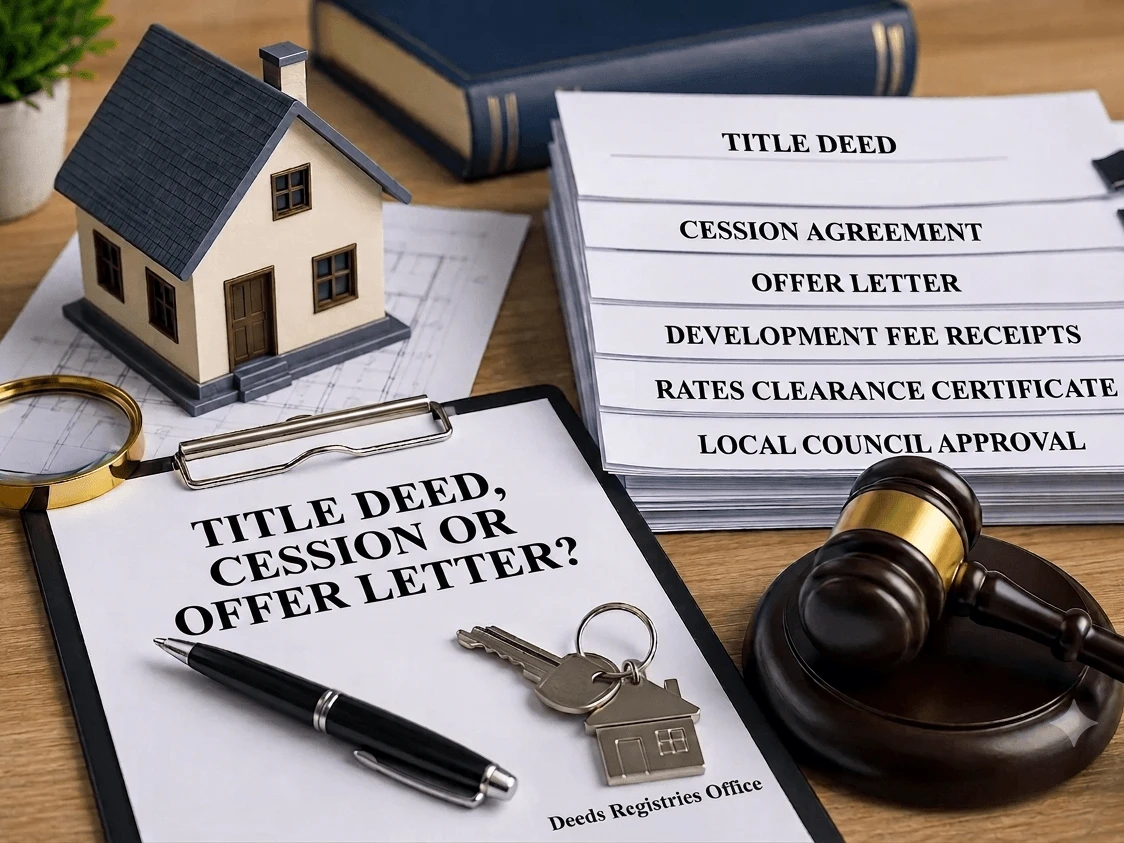
Table of Contents
- Why Ownership Documents Matter
- Quick Comparison: Which Property Document Is Safest?
- Understanding Property Ownership in Zimbabwe
- 1. Deed of Transfer – The Gold Standard of Property Ownership
- 2. Sectional Title – Ideal for Apartments and Cluster Homes
- 3. Council Cession – Popular but Requires Extra Care
- 4. Developer Cession – Buy Carefully
- 5. Offer Letters – A Good Starting Point, But Not Proof of Ownership
- 6. Block Share Certificates – An Older Form of Property Ownership
- 7. Deed of Grant – The Foundation of Every Title
- Common Property Document Mistakes Buyers Make
- Property Scams to Watch Out For
- Your Due Diligence Checklist Before Buying
- What Zimbabwean Courts Have Said About Property Rights
- Frequently Asked Questions
- Which Ownership Document Is Best for You?
- A Simple Decision Tree for Buyers
- Five Golden Rules Every Buyer Should Follow
- Final Thoughts
Before You Buy Property in Zimbabwe, Ask This One Question…
"What ownership document comes with the property?"
It sounds like a simple question, yet it is one that has saved many Zimbabwean property buyers from making costly mistakes.
Every year, buyers lose thousands of dollars after purchasing land or homes they believed they legally owned only to discover years later that they held nothing more than an allocation letter, an unregistered cession, or documents that could not be transferred into their names.
At Property.co.zw, we've seen demand for residential property continue to grow, particularly in Harare's northern suburbs, while serviced stands remain among the most searched property categories across the country. As more Zimbabweans invest in property, understanding what you're actually buying has become just as important as negotiating the purchase price.
The reality is that not every property ownership document provides the same legal protection.
Some documents give you full ownership recognised by Zimbabwean law. Others simply record contractual rights that depend on another party fulfilling future obligations.
Knowing the difference could save you from:
- Buying land that cannot legally be transferred.
- Failing to obtain bank financing.
- Delays when selling your property.
- Ownership disputes.
- Costly court battles.
In this guide, we'll explain the most common property ownership documents in Zimbabwe, what rights each one gives you, and how to verify them before paying a deposit.
Why Ownership Documents Matter
A beautiful house can be rebuilt. Money can be earned again.
But buying a property with defective ownership documents can leave you fighting for years to recover your investment.
Zimbabwean courts have consistently emphasised that registered real rights enjoy stronger legal protection than merely personal contractual rights. This distinction has been reinforced through numerous property disputes involving competing ownership claims, fraudulent sales, and unregistered interests.
For this reason, experienced conveyancers always recommend verifying the legal status of a property before signing an Agreement of Sale.
Quick Comparison: Which Property Document Is Safest?
| Ownership Document | Ownership Security | Bank Finance | Investment Risk | Can You Sell It? |
|---|---|---|---|---|
| Deed of Transfer | ⭐⭐⭐⭐⭐ | Yes | Very Low | ✅ |
| Sectional Title | ⭐⭐⭐⭐⭐ | Yes | Very Low | ✅ |
| Certificate of Registered Title | ⭐⭐⭐⭐ | Yes | Low | ✅ |
| Council Cession | ⭐⭐⭐ | Sometimes | Medium | Usually |
| Developer Cession | ⭐⭐ | Rarely | High | Limited |
| Offer Letter | ⭐ | No | Very High | Usually No |
| Block Share Certificate | ⭐⭐⭐ | Sometimes | Medium | Yes |
Tip: While some documents carry higher risk than others, the safety of any transaction also depends on proper due diligence, legal advice, and verification of the seller's rights.
Understanding Property Ownership in Zimbabwe
Many buyers assume every property comes with a title deed. That isn't always the case.
Depending on where the property is located and how it was developed, ownership may be evidenced by different legal documents.
The most common include:
- Deed of Transfer
- Deed of Grant
- Sectional Title
- Council Cession
- Developer Cession
- Offer Letter
- Block Share Certificate
Each document offers different legal rights. Let's examine them one by one.
1. Deed of Transfer – The Gold Standard of Property Ownership
If you're buying a home in established suburbs such as Borrowdale, Mount Pleasant, Greendale, Avondale or Hillside, chances are the property is held under a Deed of Transfer.
This is the document most Zimbabweans refer to as a Title Deed.
A Deed of Transfer is registered at the Deeds Registry and records:
- The registered owner.
- Stand number and property description.
- Purchase history.
- Mortgage bonds.
- Servitudes.
- Restrictive conditions affecting the land.
Once registered, it provides one of the strongest forms of ownership recognised under Zimbabwean law. The owner may generally sell, mortgage, lease, or bequeath the property, subject to any registered conditions or legal restrictions. The Deeds Registry maintains the official record of these rights.
Best suited for
- Residential homes
- Commercial buildings
- Investment properties
- High-value real estate
Can banks finance it?
Yes
Risk Level
Very Low
2. Sectional Title – Ideal for Apartments and Cluster Homes
Modern developments across Harare, Bulawayo and other urban centres increasingly use Sectional Title Ownership.
Instead of owning an individual piece of land, you own:
- Your housing unit.
- An undivided share in the common property.
This ownership model is common in:
- Apartments
- Townhouses
- Retirement villages
- Gated communities
- Cluster developments
Owners also become members of the body corporate responsible for maintaining shared facilities such as:
- Roads
- Gardens
- Swimming pools
- Security systems
- Boundary walls
Because these developments are professionally managed, sectional title properties are often attractive to investors seeking lower maintenance responsibilities.
Can banks finance it?
Yes
Risk Level
Very Low
3. Council Cession – Popular but Requires Extra Care
Many affordable residential stands are sold under Council Cession.
This is especially common in:
- Ruwa
- Caledonia
- Budiriro
- Southlea Park
- Parts of Chitungwiza
- Norton
- Some new municipal developments
A council cession records that the local authority has allocated or transferred its contractual interest in a stand to another person. Unlike a registered title deed, it is not recorded at the Deeds Registry and generally confers personal contractual rights rather than registered real rights.
Advantages
- More affordable.
- Common in growing suburbs.
- Can later convert to title once development requirements are met.
Risks
- Infrastructure may still be incomplete.
- Banks may have stricter lending requirements.
- Additional steps may be needed before title deeds can be issued.
- Transfers depend on compliance with council procedures.
Can banks finance it?
Sometimes. Policies vary by lender and the stage of development.
Risk Level
Medium
4. Developer Cession – Buy Carefully
Purchasing directly from a developer can be an excellent investment opportunity, particularly in fast-growing residential estates.
However, buyers should understand exactly what they are receiving.
A developer cession is a private contractual agreement between the purchaser and the developer. Until all statutory approvals are obtained and title is registered, it does not provide the same legal protection as a registered title deed.
This doesn't mean every developer cession is unsafe.
Many reputable developers successfully complete infrastructure and eventually issue title deeds.
The key is conducting thorough due diligence.
Before committing to a purchase, ask:
- Has the subdivision been approved?
- Are compliance certificates available?
- What is the expected timeline for title deeds?
- Has the developer completed previous projects successfully?
- Is the land free from disputes or competing claims?
Risk Level
Medium to High
5. Offer Letters – A Good Starting Point, But Not Proof of Ownership
An Offer Letter is one of the most misunderstood property documents in Zimbabwe.
Many first-time buyers mistakenly believe that holding an offer letter means they legally own the property.
In reality, an offer letter generally gives the holder permission to occupy or acquire the property subject to meeting specific conditions. It is not the same as a registered title deed.
Offer letters are commonly issued for:
- State land allocations
- Some local authority allocations
- Agricultural land
- New housing schemes
An offer letter usually outlines:
- The allocated stand or property
- Conditions attached to the allocation
- Development obligations
- Payment requirements
- Timeframes for compliance
Until all legal requirements have been satisfied and ownership has been registered where applicable, an offer letter should not be treated as conclusive proof of ownership.
Can you sell property held under an Offer Letter?
Sometimes but only where the issuing authority permits the transfer and all legal requirements have been met.
Can banks finance it?
Generally No.
Investment Risk
High
6. Block Share Certificates – An Older Form of Property Ownership
If you're buying an apartment in older parts of Harare like:
- The Avenues
- Avondale
- Milton Park
- Belgravia
you may come across a Block Share Certificate instead of a Title Deed.
Under this arrangement:
- A company owns the entire apartment block.
- Buyers purchase shares in that company.
- The shares grant the exclusive right to occupy a particular apartment.
Unlike sectional title ownership, there is no individual title deed for each apartment.
Advantages
- Often more affordable than sectional title units.
- Common in established neighbourhoods.
- Suitable for rental investments.
Considerations
Before purchasing:
- Review the company's Articles of Association.
- Confirm the share certificate is genuine.
- Understand the rules governing transfers.
- Verify monthly levies.
- Check whether banks will finance the purchase.
Bank Finance
Some lenders will finance block share purchases, although lending policies vary.
Investment Risk
Medium
7. Deed of Grant – The Foundation of Every Title
Most buyers never see a Deed of Grant, yet it forms the beginning of almost every lawful title chain.
A Deed of Grant is the legal instrument through which the State originally grants land to a local authority, developer, organisation, or private individual.
Every valid Deed of Transfer ultimately traces its history back to an originating grant. A missing or defective title chain can indicate significant legal issues that require investigation.
Although buyers rarely receive a Deed of Grant directly, conveyancers routinely examine the title history during due diligence.
Common Property Document Mistakes Buyers Make
Even experienced investors occasionally focus only on the location or asking price and overlook the legal status of the property.
Here are some of the most common mistakes.
Paying a Deposit Before Verifying Ownership
Excitement can cloud judgement. Never assume the seller owns the property simply because they possess documents. Always verify ownership through an independent conveyancer.
Confusing a Cession with a Title Deed
These documents are not interchangeable. While many cession properties eventually convert to title deeds, they carry different legal rights and transfer procedures. Understanding the distinction can help you make better investment decisions.
Buying Without a Deeds Search
A Deeds Registry search may reveal:
- Existing mortgage bonds
- Caveats
- Servitudes
- Restrictive conditions
- Registered owner details
- Outstanding legal issues
Many disputes could have been avoided through this relatively straightforward due diligence step.
Ignoring Municipal Compliance
Even where ownership appears legitimate, buyers should confirm:
- Rates clearance
- Approved subdivision permits
- Building approvals
- Survey diagrams
- Compliance certificates where required
Property Scams to Watch Out For
Zimbabwe's property market offers excellent opportunities but, like any market, it also attracts fraudsters. Watch for these warning signs.
1. Fake Title Deeds
Fraudsters sometimes produce forged title deeds that appear genuine.
Always verify the document through the Deeds Registry before making payment.
2. Double Sales
Unscrupulous sellers occasionally attempt to sell the same property to multiple buyers.
This is more common where ownership is evidenced only by private agreements rather than registered title.
3. Fake Powers of Attorney
Where someone claims to be selling on behalf of the owner:
- Confirm the Power of Attorney is authentic.
- Verify it has not expired.
- Ensure it authorises the specific transaction.
4. Illegal Subdivisions
Some land is marketed before subdivision approvals have been obtained.
Ask to see:
- Approved subdivision permits.
- Survey diagrams.
- Local authority approvals.
Your Due Diligence Checklist Before Buying
Before signing an Agreement of Sale, make sure you can answer "Yes" to each of these questions.
- Has ownership been verified?
- Have you instructed an independent conveyancer?
- Has a Deeds Registry search been completed?
- Are municipal rates up to date?
- Are there any mortgage bonds registered?
- Have subdivision approvals been issued (where applicable)?
- Does the seller have legal authority to sell?
- Have you physically inspected the property?
Completing these checks can significantly reduce the risk of disputes after purchase.
What Zimbabwean Courts Have Said About Property Rights
Zimbabwean courts have consistently reinforced the importance of registered property rights and lawful transfer procedures.
For example:
- Mujuru v Attorney-General of Zimbabwe highlighted the constitutional importance of property rights and lawful administrative action concerning property.
- Commercial Farmers Union & Others v Minister of Lands & Rural Resettlement remains an important authority in discussions surrounding property rights and land administration.
- Courts have also repeatedly emphasised that purchasers should conduct proper due diligence before relying on unregistered documents or informal agreements.
These decisions reinforce an important lesson:
A properly registered property interest offers significantly stronger legal protection than an informal or unregistered arrangement.
In addition to case law, buyers should be familiar with:
- Deeds Registries Act [Chapter 20:05]
- Regional Town and Country Planning Act [Chapter 29:12]
- Land Survey Act [Chapter 20:12]
- Constitution of Zimbabwe (Section 71 – Property Rights)
Understanding these legal principles can help buyers appreciate why conveyancing and title verification are essential steps in any property transaction.
Frequently Asked Questions
1. What is the safest property ownership document in Zimbabwe?
A Deed of Transfer (Title Deed) is generally regarded as the strongest form of private property ownership in Zimbabwe. It is registered at the Deeds Registry, records the legal owner, and provides enforceable ownership rights, subject to any registered encumbrances or legal restrictions.
2. Is buying property under cession safe?
Yes provided you carry out proper due diligence. Many legitimate developments begin under council or developer cession before title deeds are issued.
Before purchasing, make sure you:
- Verify who issued the cession.
- Confirm the seller has authority to transfer it.
- Check whether the local authority or developer has approved the transfer.
- Instruct a conveyancer to review the documentation.
The risk usually comes from poor verification, not the document itself.
3. Can banks finance properties held under cession?
It depends. Many financial institutions prefer registered title deeds because they offer stronger security.
However, some lenders may finance:
- Council cession properties.
- Certain developer projects.
- Block share properties.
Approval depends on factors such as:
- The lender's credit policy.
- Infrastructure completion.
- Development approvals.
- The borrower's financial profile.
Always check with your bank before committing to the purchase.
4. How do I verify that a title deed is genuine?
The safest approach is to instruct a registered conveyancer to conduct a Deeds Registry Search.
The search confirms:
- Registered ownership.
- Mortgage bonds.
- Caveats.
- Servitudes.
- Restrictive conditions.
- The property's title history.
Never rely solely on photocopies supplied by a seller.
5. Can I sell property without a Title Deed?
Yes, in some cases. Properties held under:
- Council Cession
- Developer Cession
- Block Share Certificates
can often be transferred using the procedures applicable to those ownership structures.
However, the transfer process is different from that used for registered title deeds and usually requires additional approvals.
6. What's the difference between a Council Cession and a Developer Cession?
A Council Cession is issued by a local authority.
A Developer Cession is issued by a private property developer.
Both generally confer contractual rights rather than registered ownership, but their transfer procedures, approval requirements, and timelines for title conversion may differ.
7. Can foreigners own property in Zimbabwe?
Yes. Foreign nationals can own certain categories of immovable property in Zimbabwe, although restrictions apply to agricultural land and some land tenure systems.
Because regulations can vary depending on the property type and ownership structure, foreign buyers should always obtain independent legal advice before purchasing.
8. What happens if a developer never issues title deeds?
If title deeds are delayed, purchasers generally continue relying on their contractual rights under the sale agreement or cession.
This is why buyers should investigate:
- The developer's track record.
- Infrastructure completion.
- Compliance certificates.
- Previous projects delivered.
- Expected title issuance timelines.
Buying from an established developer with a proven history significantly reduces this risk.
Which Ownership Document Is Best for You?
Every buyer has different objectives. Here's a quick guide.
| Buyer Type | Recommended Document |
|---|---|
| First-time Home Buyer | Deed of Transfer |
| Property Investor | Deed of Transfer or Sectional Title |
| Buy-to-Let Investor | Sectional Title |
| Commercial Investor | Registered Title |
| Stand Buyer | Council Cession (after due diligence) |
| Estate Development Investor | Developer Cession (experienced investors only) |
| Budget-Conscious Buyer | Council Cession |
| Apartment Buyer | Sectional Title or Block Share (subject to due diligence) |
A Simple Decision Tree for Buyers
Are you buying a completed house?
Yes
Does it have a registered Title Deed?
- Yes → Proceed with normal conveyancing.
- No → Ask why and obtain legal advice before paying a deposit.
Are you buying a residential stand?
Who owns the development?
- Local Authority → Council Cession.
- Private Developer → Developer Cession.
Has infrastructure been completed?
Have subdivision approvals and compliance certificates been issued?
What is the expected timeframe for title deeds?
If you cannot obtain satisfactory answers to these questions, pause the transaction and seek professional advice.
Five Golden Rules Every Buyer Should Follow
1. Never rush into paying a deposit.
A few extra days spent verifying documents can save years of legal disputes.
2. Always use your own conveyancer.
Do not rely solely on professionals appointed by the seller. Independent advice protects your interests.
3. Verify every document.
If a document cannot be independently verified, treat it as a warning sign until proven otherwise.
4. Don't buy because everyone else is buying.
Rapidly growing developments can present excellent opportunities but they also require careful due diligence.
5. Think long-term.
The cheapest property isn't always the best investment. Consider:
- Future resale value.
- Ease of obtaining finance.
- Infrastructure.
- Security of ownership.
- Long-term appreciation.
Final Thoughts
Property ownership is about much more than receiving a set of keys. It's about acquiring legally enforceable rights that protect your investment for years to come.
Whether you're buying your first home, investing in rental property, or acquiring land for future development, understanding the ownership document you're receiving is one of the smartest decisions you can make.
A title deed may provide the strongest protection, but many successful property investments in Zimbabwe begin under cession or other ownership structures. The key difference is knowledge.
Buyers who understand the legal status of a property, verify documents thoroughly, and work with qualified professionals are far more likely to enjoy a smooth transaction and long-term peace of mind.
At Property.co.zw, we believe informed buyers make better investors. That's why we encourage every purchaser to ask questions, verify documents, and seek professional advice before signing any agreement.
Whether you're looking for a family home, a residential stand, or your next investment opportunity, Property.co.zw connects you with verified listings, trusted estate agents, and expert market insights to help you buy with confidence.