Continue with Facebook
 Continue with Email


Table of Contents
- What the Chitungwiza Warnings Show
- Start by Identifying the Property Right
- Where to Verify Different Types of Property in Zimbabwe
- Seven Property Verification Checks Before Buying, Building or Selling
- Warning Signs That Deserve Further Investigation
- Early Verification and Deferred Verification Compared
- Diaspora Property Owners Need Independent Reporting
- Council Verification, Registry Searches and Deed Validation Are Different
- Two Additional Strategic Actions to Protect Property Value
- Conclusion
A finished house can conceal an unfinished ownership record. A stand can be fenced, occupied and supported by years of payment receipts while its allocation, boundaries or transfer rights remain unresolved.
For Zimbabwean buyers, existing owners and diaspora investors, that gap can be expensive. Problems may surface only when a property is sold, offered as security, developed further or passed to the next generation.
Property verification in Zimbabwe means checking that the holder, land parcel, legal right and development approvals agree with the relevant official records. The documents and institutions involved depend on the property's tenure. A title deed, council offer letter, lease, cession and communal occupation right each require a different approach.
Chitungwiza's reported verification exercises illustrate the issue, but the lesson applies across Zimbabwe: confidence in a property should rest on independently confirmed records.
What the Chitungwiza Warnings Show
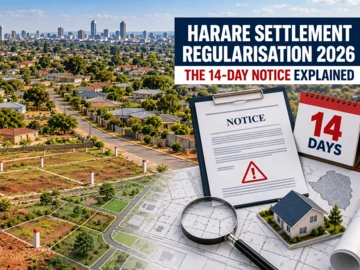
In February 2024, The Herald reported that Chitungwiza Municipality was verifying offer letters issued from 2019 onwards following concerns about fraudulent allocations. This concerned specified municipal records; it was not a nationwide order requiring every Zimbabwean property owner to attend verification. Read the reported notice.
A further warning followed in June 2026. According to reporting on a council notice, the municipality disowned purported stands near Zengeza 8 Primary School in Zengeza 3 and said no individual, group or company had been authorised to peg, allocate or sell that land on its behalf. Read the report.
The practical lesson is clear: apparent development activity and convincing paperwork require verification at their source. A document supplied by the seller should be checked with the institution said to have issued it.
Affected Chitungwiza beneficiaries should confirm current requirements directly with the municipality. Historical notices should not be treated as fresh deadlines.
Start by Identifying the Property Right
The Ministry of National Housing and Social Amenities distinguishes between property acquired from individuals, local authorities, companies and Government. Its guidance recommends a Deeds Registry search where title exists and confirmation with the appropriate council or ministry where it does not. Ministry guidance on acquiring a house.
Before assessing any paperwork, establish:
- Who controls the underlying land? Identify the registered owner, council, State institution or other lawful landholder.
- What right is being offered? Determine whether it is registered ownership, leasehold, an allocation, a contractual interest or another recognised right.
- What can legally be transferred? Establish the required consent, conditions and registration or administrative process.
- What use is permitted? Confirm that the proposed home, rental development, business or agricultural activity fits the approvals.
Property without individual title is not automatically fraudulent. An allocation or contractual right may be legitimate. Its nature, limitations and route to transfer must be described accurately rather than presented as immediate registered ownership.
Where to Verify Different Types of Property in Zimbabwe
| Property profile | Starting point for verification | Evidence to reconcile |
|---|---|---|
| Registered freehold property | Deeds Registry through an independent conveyancer | Registered holder, deed description, survey information and recorded burdens |
| Council stand or house without individual title | Relevant council housing or estates department | Allocation, lease or home ownership agreement, beneficiary record, cessions and transfer conditions |
| Developer stand or cooperative allocation | Conveyancer, underlying landholder and planning authority | Parent land right, subdivision approvals, seller authority and allocation or contractual chain |
| Government housing or State land allocation | Responsible ministry or authorised programme office | Authentic allocation, lease or permit, beneficiary details and conditions |
| State agricultural land | Ministry responsible for lands and specialist legal adviser | Current tenure document, allocation record, permitted use and rules governing any proposed dealing |
| Communal land | Relevant rural district council and lawful traditional structures | Lawful occupation or settlement rights and applicable land use requirements |
| Sectional title unit | Conveyancer, Deeds Registry and body corporate | Unit title, sectional plan, scheme rules, common property position and levies |
Communal land needs particular care. The Communal Land Act regulates occupation and use through statutory rights, consents and permits. The Traditional Leaders Act also restricts dealings in communal land and settlement rights. Neither a handwritten agreement nor a payment to an intermediary establishes an unrestricted right to sell the land as private freehold. Communal Land Act · Traditional Leaders Act.
Seven Property Verification Checks Before Buying, Building or Selling
These are seven areas of due diligence, rather than a universal list of seven statutory documents. The evidence needed depends on the tenure, transaction and intended use.
1. Verify the Holder and Everyone Acting on Their Behalf
The person offering the property must either hold the relevant right or have valid authority to represent its holder.
An independent conveyancer should check:
- identity details against the governing property record
- the authority of company directors or other representatives
- trustee powers where a trust holds the property
- executor authority for a deceased estate
- the participation or consent required from co owners
- the scope and authentication of any power of attorney.
Possession of keys, original papers or a relative's verbal permission does not, by itself, establish authority to sell. This distinction is especially important for inherited property and transactions managed from abroad.
2. Authenticate the Governing Title or Tenure Record
For titled property, compare the seller's document with the current Deeds Registry record. Confirm the registered owner, property description and relevant registered burdens, including mortgage bonds or caveats.
For council, State or developer administered rights, obtain confirmation from the institution that maintains the controlling record. It should identify:
- the beneficiary or right holder
- the stand and scheme
- the type of tenure
- any outstanding conditions
- the process and consents required for transfer.
A photocopy, official looking stamp or forwarded verification letter should not be the sole basis for committing funds. The enquiry should reach the institution through independently established contact details.
3. Reconstruct the Allocation and Transfer History
The file should explain how the current holder acquired the right and whether each necessary step was completed.
Depending on the property, review the original allocation, sale agreement, lease, cession, consent, payment evidence, estate documents and registered transfer.
Common problems include:
- an informal resale never entered into the council or developer's records
- a deceased original beneficiary whose estate remains unresolved
- more than one sale or allocation of the same property
- a missing consent
- an unpaid balance affecting transferability.
An administrative omission may be correctable. A forged allocation or unauthorised sale presents a different problem. The legal review should identify the defect and the lawful remedy before a buyer assumes either outcome.
4. Match the Physical Site to the Parcel Records
The property shown during a viewing must correspond with the land described in the documents.
Reconcile the stand number, scheme or township, area, boundaries and relevant layout or survey record. Where a stand has been renumbered, obtain the documented link between its old and current descriptions.
A fence, road sign, peg or seller's sketch is not conclusive evidence of the legal boundary. Engage a registered land surveyor where the site identity, extent or boundary position is uncertain.
This check is particularly valuable for peri urban stands, subdivisions, vacant land and developments where roads or site markings are incomplete.
5. Confirm Subdivision, Planning and Land Use Approval
Ownership and development permission answer different questions. A lawful landholder cannot assume that every proposed subdivision or use is permitted.
Zimbabwe's Regional, Town and Country Planning Act governs development control and subdivision. Ministry guidance likewise directs housing developers to the local planning authority and the relevant survey approvals. Planning Act · Ministry guidance on accessing housing land.
Check whether the proposed stand and use agree with the approved records. Investigate land represented as residential where it may instead be reserved for roads, utilities, schools or open space. Wetland concerns require confirmation of the applicable environmental and planning requirements.
A promise that approval will follow payment should be examined by the conveyancer. A private agreement cannot itself supply a missing public approval.
6. Compare Building Approvals With the Existing Structures
The verification process should cover the buildings as well as the land.
Compare approved plans and relevant inspection or occupation records with what exists on site, including:
- extensions and additional dwellings
- cottages and converted garages
- boundary structures where approval is required
- conversions into offices, shops, schools, clinics or hospitality premises.
An authorised main house does not automatically authorise later alterations. Unresolved work can create costs and delays during a sale or lender assessment. Insurance implications depend on the policy, disclosure and circumstances, so they should be checked rather than assumed.
7. Check Financial Obligations, Disputes and Transfer Conditions
Obtain current information on the obligations relevant to the asset:
- rates, service accounts and levies
- purchase price or development balances
- mortgage debt and cancellation requirements
- leases, occupiers and possession arrangements
- competing claims, litigation or enforcement notices
- the clearances and consents needed for the proposed transaction.
A clear account proves a payment position. It does not establish title, approve a structure or resolve a boundary dispute. Similarly, a registry search alone will not necessarily reveal every contractual or occupation problem. Institutional enquiries and a physical inspection should complement the legal review.
Warning Signs That Deserve Further Investigation
Before a new payment or construction commitment, escalate inconsistencies such as:
- refusal to allow a direct registry, council or ministry check
- unexplained differences in names, stand numbers or areas
- payments requested into a personal account by someone claiming to represent a public institution
- multiple claimants with competing allocation or sale documents
- a cooperative unable to demonstrate its right to the underlying land
- a development advertised without verifiable approvals
- a seller who cannot explain the route to transfer
- pressure to pay immediately while verification is deferred.
A low price cannot resolve defective authority or an unlawful allocation. Where a contract already exists, obtain legal advice before withholding a payment or taking other action that could breach it.
Early Verification and Deferred Verification Compared
| Decision factor | Verification before commitment | Verification postponed until a problem arises |
|---|---|---|
| Initial expenditure | Search and professional costs arise early | Costs appear lower at the outset |
| Defect discovery | Problems can inform the decision, price and lawful conditions | Funds or building costs may already be exposed |
| Construction | Parcel identity and approvals can be checked before work begins | Rectification may involve completed structures |
| Resale and finance | A coherent file supports buyer and lender review | Missing records may delay or prevent a transaction |
| Succession | The right and supporting documents are easier to identify | Heirs may need to reconstruct an incomplete history |
| Remote ownership | Independent checks support oversight | The owner may depend on one representative's account |
Verification does not guarantee a dispute free investment or lender approval. Its commercial value lies in discovering material problems while decisions and expenditure can still be controlled.
Diaspora Property Owners Need Independent Reporting
For owners abroad, site access, document custody and payment instructions may sit with one relative or representative. That arrangement needs clear limits and independent checks.
A practical oversight file should contain:
- confirmations obtained directly from the relevant institutions
- dated inspection reports and photographs
- a current occupier and tenancy schedule
- a limited, clearly documented representative mandate
- verified payment details and transaction approvals
- a record of who holds original deeds, leases, plans and agreements.
The person introducing a purchase should not control every part of its verification. An independent conveyancer and, where needed, surveyor or planning professional should report directly to the principal.
Council Verification, Registry Searches and Deed Validation Are Different
These processes should remain distinct:
- Council verification checks municipal allocations, beneficiary details and related records.
- A Deeds Registry search checks registered rights and recorded burdens.
- Deed validation and securitisation concern the authenticity and replacement processes within the registry framework.
Statutory Instrument 76 of 2025 contains separate commencement, validation and transitional provisions. Its commencement clause requires a date fixed by further statutory instrument, while its validation and transitional clauses use different date references. A replacement deadline should therefore be confirmed against the operative Gazette notices and current registry instructions. SI 76 of 2025.
Completing a council exercise does not discharge a registered mortgage or approve a subdivision. Equally, validating a deed does not approve an unauthorised building or change of use.
Two Additional Strategic Actions to Protect Property Value
1. Obtain a Written Reconciliation Report Before Committing Capital
Commission the conveyancer to reconcile three sets of evidence for the same property:
- the registered or underlying ownership right
- the allocation, beneficiary or transfer history
- the planning and survey records.
The report should state what right exists, who holds it, whether the proposed transaction is lawful, what consents remain and which discrepancies require correction. Add a surveyor where physical boundaries do not align with the records.
Where appropriate, the lawyer can draft verification and payment conditions. Such conditions cannot cure a transaction prohibited by law legality must be established first.
2. Introduce an Annual Property Records Review
Diaspora families, portfolio owners and investment syndicates should maintain a dated annual review of occupation, accounts, tenure records, approved use, alterations, disputes, insurance and original document custody.
Assign responsibility for each issue, record the evidence reviewed and set a correction date. Significant events such as a new occupier, death of a holder, proposed subdivision or disputed allocation should trigger an immediate review.
This is an asset management measure, not a universal statutory annual certification requirement. It helps prevent a complete file from becoming outdated as the property and its ownership circumstances change.
Conclusion
Property verification protects the ability to occupy, develop, finance, sell and pass on an asset. The appropriate checks follow the legal right and the intended transaction, wherever in Zimbabwe the property is situated.
- Buyers: Confirm the seller's authority, tenure, parcel and approvals before making a new financial commitment.
- Existing owners: Resolve discrepancies before refinancing, extending the property or planning succession.
- Council, developer and cooperative beneficiaries: Verify the underlying land right, beneficiary history and lawful route to transfer.
- Diaspora owners: Require independent institutional checks, controlled representative authority and periodic inspections.
- Developers and investment syndicates: Make legal, survey and planning verification part of capital approval.
- Sellers: Prepare a coherent property file before listing and describe the tenure accurately.
Where the holder, parcel, transfer history or lawful use cannot be reconciled, the next step is a documented resolution with the competent authority and professional advisers. Substantial new expenditure should follow that resolution.